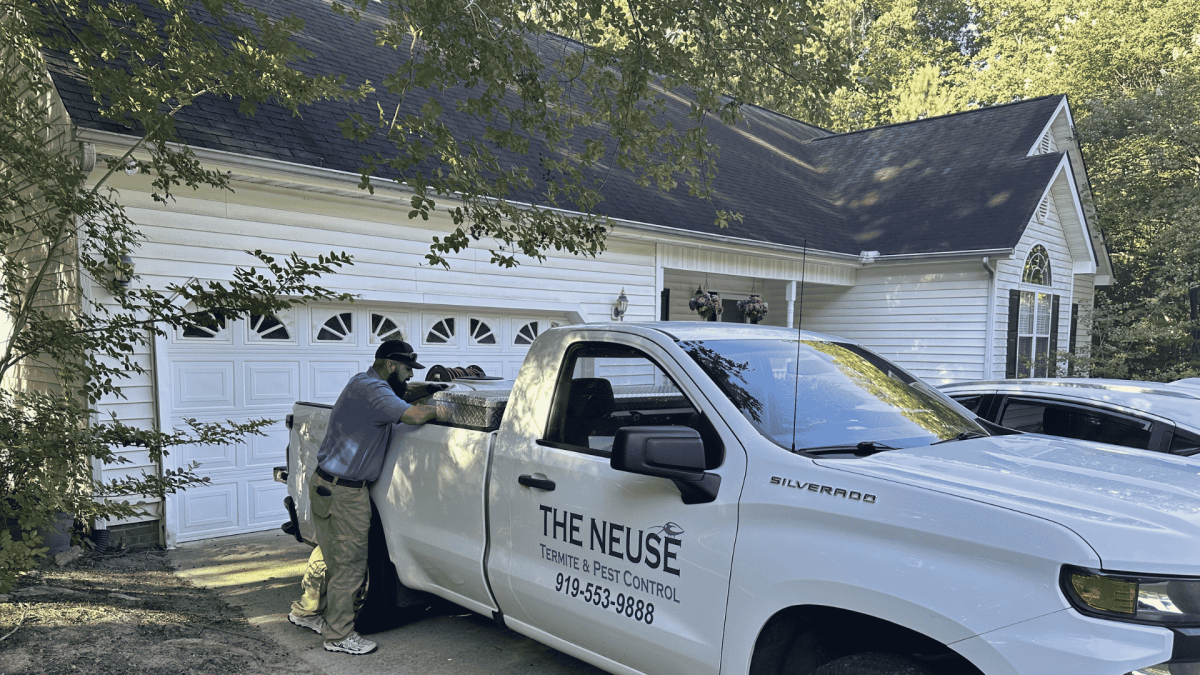
Semi-rural communities like Whitsett attract homeowners who want space, natural surroundings, and something that feels less managed than a typical subdivision. The trade-off is that those natural surroundings bring pest pressures that more manicured suburban environments keep at a greater distance. When your property borders wooded land, when larger lots mean more surface area exposed to outdoor pest populations, and when the surrounding landscape is alive with the insects and arachnids that naturally inhabit the piedmont, the path from outside to inside is shorter and more traveled than most homeowners would prefer.
Neuse Termite and Pest Control serves Whitsett from our Burlington location at 3671 Alamance Rd, bringing quarterly residential pest control backed by a 5-star rating from over 2,000 customers across Central NC.
What Drives Pest Pressure in Whitsett
Wooded Borders and Natural Lot Edges
Whitsett's residential properties frequently back up to wooded areas, undisturbed land, or natural buffers that sustain large, established populations of spiders, ants, centipedes, and other common pests year-round. These populations expand seasonally, and the edge zones between developed residential lots and natural areas are where that pressure concentrates and moves toward structures most consistently. Quarterly perimeter treatment addresses exactly those transition zones.
Larger Lot Surface Area
Bigger lots mean more exposed foundation perimeter, more potential entry points, and more landscape area where pests can establish close to the house. A standard suburban lot has a relatively short distance between the property edge and the structure. On a larger Whitsett lot, more ground, more plantings, and more outdoor activity areas sit between the boundary and the house, and pests use all of it.
Moisture and Organic Material Near Structures
The natural character that makes Whitsett properties appealing, including established trees, native plantings, and organic mulch around foundation beds, creates moisture-retentive conditions directly against exterior walls. Moisture-seeking insects including centipedes, earwigs, and silverfish concentrate in these areas before making their way indoors through foundation gaps and utility penetrations.
How Neuse Residential Pest Control Works
Quarterly Service Timed to the Season
Each quarterly visit is calibrated to the pest pressures most active at that point in the year. Spring treatment addresses ant colony expansion and the onset of exterior nesting activity. Summer service maintains perimeter pressure during peak season. Fall treatment addresses the entry points that overwintering insects exploit as temperatures drop. Winter service maintains baseline protection.
What Each Visit Covers
Every quarterly service includes:
- Exterior foundation perimeter treatment and entry point inspection
- Eaves, overhangs, and exterior window and door frames
- Landscape bed perimeters and wooded border areas adjacent to the structure
- Interior baseboard and active zone treatment where needed
- Between-visit callback at no additional charge if pest activity develops
What Is Covered
Standard quarterly service addresses the household pests Whitsett residents encounter most frequently given the semi-rural environment:
- Ants, including fire ants, odorous house ants, and pavement ants
- Spiders, including wolf spiders and common house spiders prevalent in wooded settings
- Ladybugs, boxelder bugs, and other seasonal overwintering invaders
- Cockroaches (American and other non-German species)
- Silverfish, earwigs, centipedes, and millipedes
- Wasps and hornets at accessible exterior nesting locations
German cockroach infestations require a dedicated treatment approach separate from the standard quarterly plan. Contact us directly if that is your concern.
The Semi-Rural Difference
One thing that distinguishes pest control in Whitsett from a standard suburban environment is the sustained nature of outdoor pressure. In a dense subdivision, natural areas are reduced and somewhat distant. In Whitsett, they are often directly at the property border. That proximity means there is never truly an off-season for pest activity near the structure, and it makes consistent quarterly treatment more valuable rather than less.
For homeowners who also deal with crawl space moisture, the connection between moisture and pest activity is particularly relevant in semi-rural settings where organic material is abundant near the foundation. See our moisture remediation services for how moisture and pest pressure interact.
Frequently Asked Questions About Pest Control in Whitsett
Why are spiders so persistent in semi-rural homes?
Wolf spiders and other large spider species thrive at the edges of wooded areas, which is exactly where Whitsett residential lots are situated. These spiders follow their prey into structures, and in a home near wooded land, that movement is constant rather than occasional. Quarterly perimeter treatment keeps population levels in check both at the exterior and inside.
My lot is larger than average. Does that change how treatment works?
Larger lots receive more thorough perimeter coverage, particularly around wooded border areas and the full length of the foundation. The approach scales with the property rather than applying a standard treatment regardless of lot size.
What happens between quarterly visits?
Between-visit callbacks are included at no additional charge. If pest activity appears between scheduled services, contact us and we will return to address it.
Can I bundle pest control with mosquito and termite coverage?
Yes. Both services are available through a Neuse account and can be added at any time. See our pest home protection plans for bundled coverage options.
Does Neuse serve all of Whitsett from Burlington?
Yes. Our Burlington location at 3671 Alamance Rd covers all of Whitsett and the surrounding Alamance County area. Contact us to schedule.
Schedule Pest Control in Whitsett, NC
Neuse is ready to protect your Whitsett home from our Burlington location. Contact us online today or at (336) 948-1734 to schedule quarterly pest control.

